
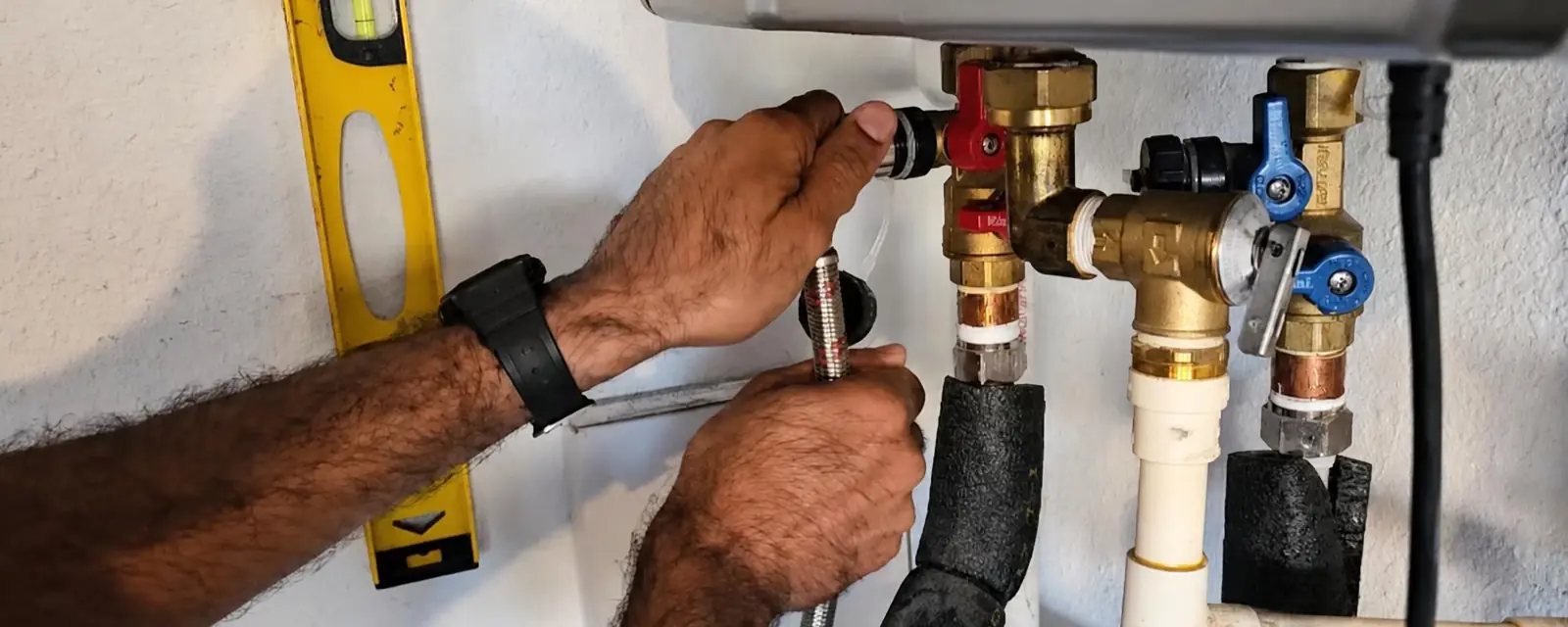
A tankless unit hangs on a wall, so the question is which wall. Three things decide it: the vent, the gas line and the distance to your fixtures.
Your main options
| Location | Good for | Watch for |
|---|---|---|
| Garage wall | Easy venting and service access | Impact from vehicles and desert summer heat |
| Exterior wall | Shortest vent path, saves interior space | Weather exposure and sun, check the unit rating |
| Utility room or closet | Protection from weather | Longer vent, combustion air and clearance |
| Attic | Saves floor space | Heat, service access and leak damage risk |
| Crawl space | Out of sight | Access, moisture and service difficulty |
An exterior wall unit is rated for outdoor use and needs no vent through the house. It gets exposed to the elements, and desert sun is intense, so check that the unit is rated for it. A garage wall is the most common choice, since it is close to the old tank and has easy access.
Gas and vent needs at each spot
A tankless heater draws far more gas at once than a tank heater. The gas line to the unit often has to be larger, and the meter must be able to supply it. The farther the unit sits from the meter, the more the line size matters. A good plumber measures the run before recommending a spot.
The vent must lead outside, usually through a wall or the roof, with clearances to windows, doors and vents. Many units use a sealed vent in plastic or stainless pipe. Mixing parts between makers is not allowed. The maker instructions control the vent type and length.
Near the fixtures
- Short hot water wait
- Less pipe to insulate
- May need a longer vent or gas run
- May be a noisy room
Near the meter
- Short, large gas line
- Lower install cost
- Longer hot water wait
- May need a recirculation line
Desert Hot Springs: garages, heat and flushing access
Garages in Desert Hot Springs can get very hot in summer, and a closed garage can push a unit toward its temperature limits. Check the maker rating for ambient temperature, and keep the space ventilated.
Mission Springs Water District publishes an annual water quality report on its website, and mineral scale is the main maintenance issue for a tankless unit. Place the heater where you can reach the service valves to flush it, since a unit boxed behind shelves will never get serviced. Our tankless water heater page explains the flush schedule.
Clearances, vent materials and gas sizing for a tankless unit follow the maker instructions and the California Plumbing Code, which is based on the Uniform Plumbing Code (UPC).
Want a tankless install plan?
Call and we will check gas, vent and space.
Clearances, drains and power
- Leave clear space around the unit as the maker specifies
- Keep stored items away from the vent and the front of the unit
- Plan a condensate drain with a neutralizer for condensing models
- Provide a nearby outlet for the controls and fan
- Install isolation valves so the unit can be flushed
- Add a pressure relief valve and a discharge line
These details seem small, but they are what an inspector checks. A unit that has no room around it overheats, and a unit with no outlet will not run. We walk the space with you and mark everything before we hang the unit.
Replacing a tank with tankless
Swapping a tank for tankless in the same spot is rarely a straight swap. The gas line, the vent and the water lines all change. A tank sits on the floor, and a tankless unit hangs on a wall, which may need blocking. If the budget is tight, a new tank heater is often the better value. See water heater installation for that route, and emergency replacement if the tank has already failed.
We serve Palm Springs homes and others across the service area, and the dispatcher can talk through your layout on the phone.
Long pipe runs and the wait for hot water
A tankless unit does not shorten the wait for hot water at a faucet. The wait depends on how far the water has to travel, and a unit far from the bathroom still has a long cold run to clear. A recirculation line or a point of use unit near a distant bathroom can help.
Plan the pipe routes when you pick the spot. Insulating the hot line reduces heat loss, and a short run saves water. If the wait for hot water bothers you now, a tankless unit will not fix it, but a different location can.
Yes, with attention to summer heat, the unit rating and protection from vehicles. Keep the space ventilated.
Maybe. The gas line, vent and water lines usually change. We measure first.
Often yes, since they draw a lot of gas at once. We check your meter and line size.
Closer means a shorter wait for hot water, but the best spot also depends on the vent and the gas.
Yes, if the unit is rated for outdoor use. Check sun, heat and weather protection.