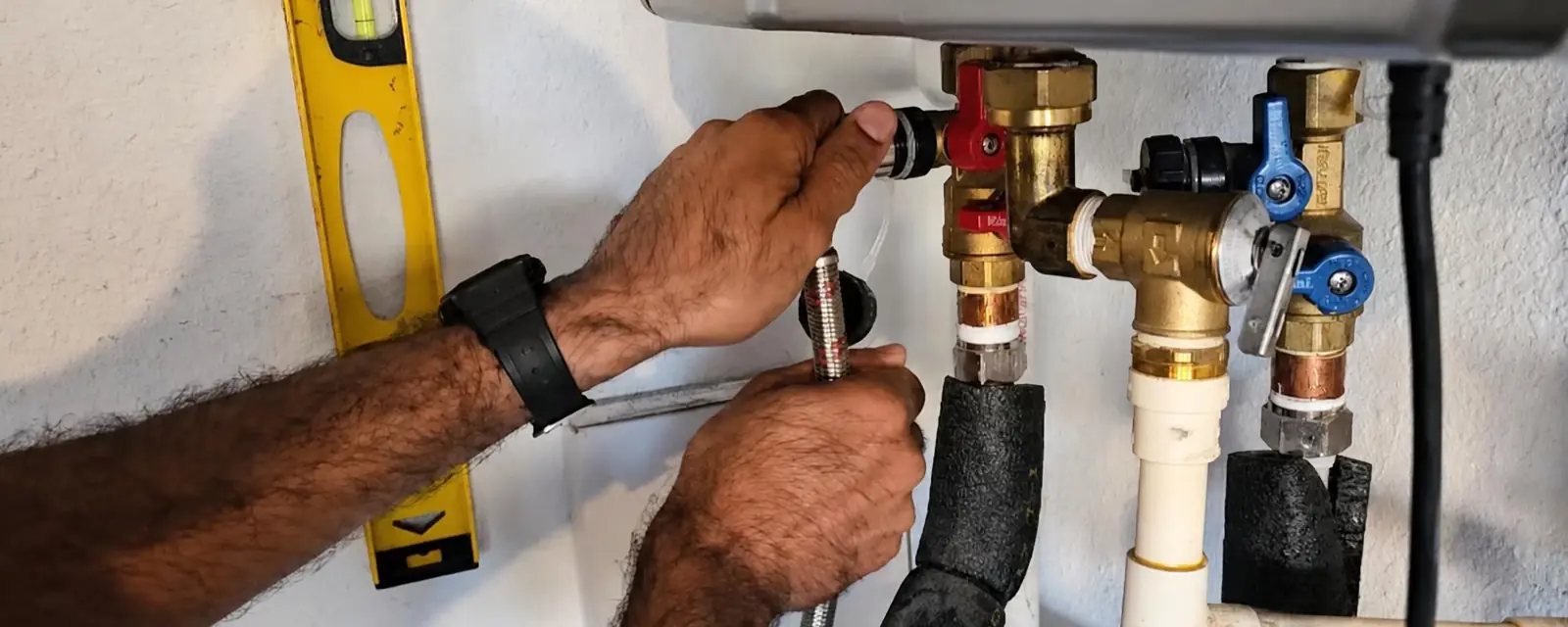
A tankless heater is a good fit when the home can feed it. That means gas capacity, a vent path and water that is not leaving thick scale inside the heat exchanger.
This page covers planned installs, repairs and maintenance. If your hot water is out right now, call the line anyway. We will tell you whether a tankless unit needs a manufacturer visit.
How tankless differs from a tank heater
Tank heater
- Stores a set volume of hot water
- Lower upfront cost
- Runs out during long demand
- Takes up floor space
Tankless heater
- Heats water on demand
- Saves space and removes standby loss
- Needs a larger gas line and vent
- Needs regular descaling in hard water
Tankless units do not provide endless hot water. Each unit has a flow limit, so running a shower, dishwasher and washer together can exceed what one unit can heat. We size the unit to your peak use and talk about a second unit if the home needs it.
Mineral scale and flushing
Scale is the main reason tankless heaters lose performance. Mission Springs Water District publishes an annual water quality report, so we do not quote a hardness number from memory. Test your tap or read the report to see your own figures, then plan to flush the heat exchanger on a schedule your water calls for.
A flush uses a small pump and a descaling solution to circulate through the unit. Signs you are overdue include an error code, less hot water than before, a rumbling sound and temperature swings. Many owners schedule it once a year, and we adjust that interval after the first look inside.
Error codes on the display
Many codes point to flow, ignition or scale problems that a flush can address.
Lukewarm water at full flow
A scaled heat exchanger cannot transfer heat as it should.
Rumbling or whistling
Water boiling in scaled passages makes noise.
Temperature swings
Flow sensors and scale can make output unsteady.
Gas, vent and electrical needs
| Item | Why it matters | Common upgrade |
|---|---|---|
| Gas supply | Tankless burners draw a lot at once | Larger gas line or meter check |
| Vent path | Exhaust must leave safely | New vent through wall or roof |
| Electric outlet | Controls and fans need power | Outlet near the unit |
| Condensate drain | Condensing models make acidic water | Neutralizer and drain line |
| Isolation valves | Allow flushing without cutting the lines | Service valve kit |
Want to know if your home can run tankless?
Call and we will check gas, vent and space with you.
Is it worth it for a Desert Hot Springs home
A tankless unit can make sense in a remodel, in a home with little floor space or in a rental where a steady supply matters. It makes less sense when the gas line is small and a long run would be costly. We tell you plainly when a tank heater is the better value. For that route, see water heater replacement.
If the unit is already installed and not working, water heater repair covers the common diagnostic steps. The manufacturer may need to handle parts under warranty.
Tankless vent materials, gas sizing and condensate drains must follow both the maker instructions and the California Plumbing Code, which is based on the Uniform Plumbing Code (UPC).
Common tankless problems and what they mean
A cold water sandwich is the short burst of cold water between two hot draws. It happens because the unit shuts off between uses, and the water in the line cools. A recirculation line or a small buffer tank can reduce it, and we can tell you whether your layout allows one.
Ignition errors, flame failures and exhaust errors are the most common fault codes. Many trace back to a blocked vent, low gas pressure or a dirty flame sensor. We check these before we call for parts, and we tell you if the fix is covered by the manufacturer warranty.
Warranty and who services what
Tankless heaters often carry warranties that depend on the install being done by a licensed contractor and on regular maintenance. Keep your install record and your flush receipts, since a manufacturer may ask for them. We provide a written record of the work we do.
Many owners flush once a year, and hard water or heavy use may call for more often. We set the interval after we see the inside of your unit.
Sometimes, but many homes need a larger line. We measure before we quote.
No. Each unit has a flow limit, so very high demand can exceed it.
The line is open 24/7. We diagnose what we can and tell you when the manufacturer has to handle a part.
Installs are normally permitted work under the California Plumbing Code. The city Building Division can confirm your case.