Scale builds up inside every tankless unit over time. A flush removes it, and skipping it shortens the life of the heat exchanger.
Why a tankless heater needs flushing
Heating water drives minerals out of it. The minerals coat the inside of the heat exchanger, and a thin layer of scale acts like insulation. The unit works harder, the water comes out cooler, and parts wear out sooner. A flush dissolves the scale so water can pass through freely.
Every unit sees different scale, since it depends on your water and how much hot water you use. A household with high use and mineral-rich water needs a flush more often than a light user. We set the interval by looking inside the unit on the first visit.
Error codes
Many codes point to flow or heat problems that scale can cause.
Cooler water at full flow
A scaled exchanger cannot transfer heat well.
Rumbling or whistling
Water boiling in scaled passages makes noise.
Slower hot water arrival
The unit takes longer to reach set temperature.
What you need for a flush
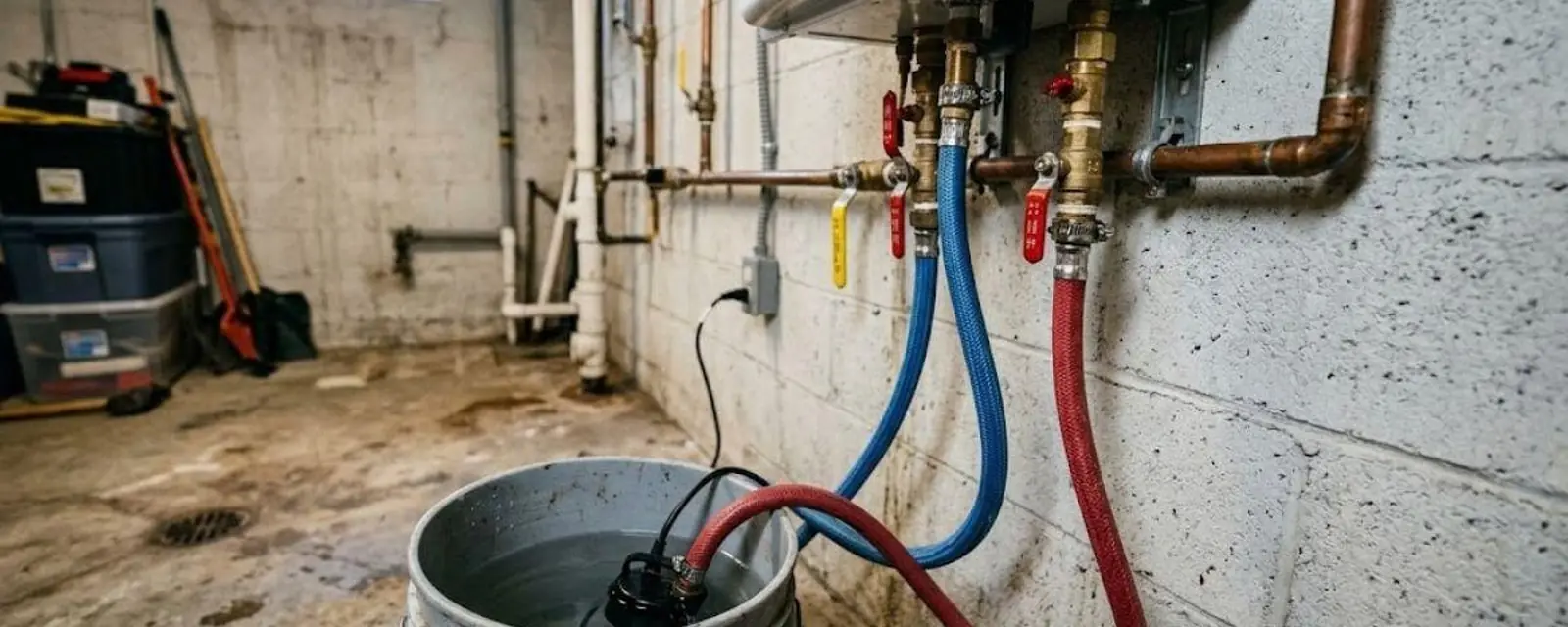
- A small submersible pump rated for descaling solution
- Two washing machine style hoses with the right fittings
- A bucket of at least five gallons
- White vinegar or a descaling product approved by the heater maker
- Isolation valves already installed on the hot and cold lines
Check your manual first. Some makers do not approve vinegar and require their own solution, and using the wrong one can void a warranty. If your heater has no isolation valves, a plumber should install a service valve kit before the first flush.
The flush, step by step
Power down
Turn off the electric supply and close the gas valve to the heater.
Close the water valves
Close the cold and hot isolation valves and open the service ports to relieve pressure.
Connect the pump and hoses
Run one hose from the pump to the cold service port and one from the hot port back to the bucket.
Circulate the solution
Pour the descaling solution into the bucket and run the pump for about an hour, then flush with clean water.
After the flush, clean the inlet water filter screen, close the service ports, open the isolation valves slowly and purge air at a hot tap. Restore gas and power, and check the display for errors. If an error stays, the cause may not be scale.
Desert Hot Springs: check your own water report
Mission Springs Water District provides drinking water to Desert Hot Springs and posts an annual water quality report on its website, including a 2025 report. We do not quote a hardness number from memory, because the right source is the report itself or a test of your own tap.
Read the report, or buy a simple test kit, and use the result to set your flush schedule. If hardness is a constant problem, a softener may protect the heater, and our water softener and filtration page explains the options.
The maker instructions decide which descaling solution is allowed, and valve and drain connections on the unit follow the California Plumbing Code, which is based on the Uniform Plumbing Code (UPC).
Prefer a plumber to flush it?
Call and we will schedule a tankless service visit.
When to leave it to a plumber
Call us if the unit has no service valves, if an error code returns after a flush, if the heater is gas and you smell exhaust, or if the heat exchanger is badly scaled. A plumber can also check the gas pressure, the vent and the flame sensor during the visit. Our tankless water heater service page covers installs, repairs and descaling.
| Situation | What to expect | Suggested approach |
|---|---|---|
| Light use, newer unit | Slow scale buildup | Check yearly and flush as needed |
| Heavy use or rental | Faster wear | Plan flushes more often |
| Softener installed | Less scale | Check yearly and adjust |
| Error codes appear | Scale or another fault | Flush, then call if codes return |
We also serve homes in Palm Springs and nearby communities. The service area page shows where we work, and the 24/7 line is open if your heater fails outright.
Mistakes that damage a tankless unit during a flush
The most common mistake is forgetting to close the isolation valves in the right order. Closing the hot side first can trap pressure, and opening a service port without relieving it sprays hot water. Always read the sequence in your manual, and wear gloves and eye protection.
The second mistake is using the wrong solution. A strong acid can attack seals and the heat exchanger. Use the product the maker names, and rinse thoroughly afterward. Do not restart the unit with the service valves still closed, or the heater will fire without water flow and trip an error.
- Do not run the pump dry, since it burns out quickly
- Do not skip cleaning the inlet filter screen
- Do not leave descaling solution in the unit overnight
- Keep a record of the flush date for the warranty
Many owners flush once a year. Check the Mission Springs Water District report or test your tap, and shorten the interval if scale is heavy.
Many makers allow white vinegar, but some require their own solution. Read the manual before you start.
Yes. Without them you cannot isolate the unit, and a plumber should install a valve kit first.
About an hour of circulation, plus time to set up, rinse and restart. Plan for two hours in total.
The cause may be a vent, a gas pressure problem or a failed sensor. Call a plumber to diagnose it.