The right system depends on what is in your water, so test first and buy second.
Mission Springs Water District provides drinking water to Desert Hot Springs and publishes an annual water quality report, including the 2025 report on its website. We do not quote hardness or contaminant numbers from memory. Read the report or test your tap, then use that information to choose a system. We can help you read the results.
What each system does
| System | What it does | What it does not do |
|---|---|---|
| Salt-based softener | Reduces hardness minerals that form scale | Does not remove most other contaminants |
| Whole house carbon filter | Reduces chlorine taste and odor | Does not soften water |
| Sediment filter | Catches sand and particles | Does not change taste or hardness |
| Under-sink reverse osmosis | Filters drinking water at one tap | Treats one tap, not the whole house |
| Scale control or conditioner | Reduces scale adhesion without salt | Does not remove hardness |
No single system fixes everything. Many homes pair a softener with an under-sink filter at the kitchen tap. We explain what each product removes in plain terms, and we tell you when a system will not solve your complaint.
Signs scale is costing you
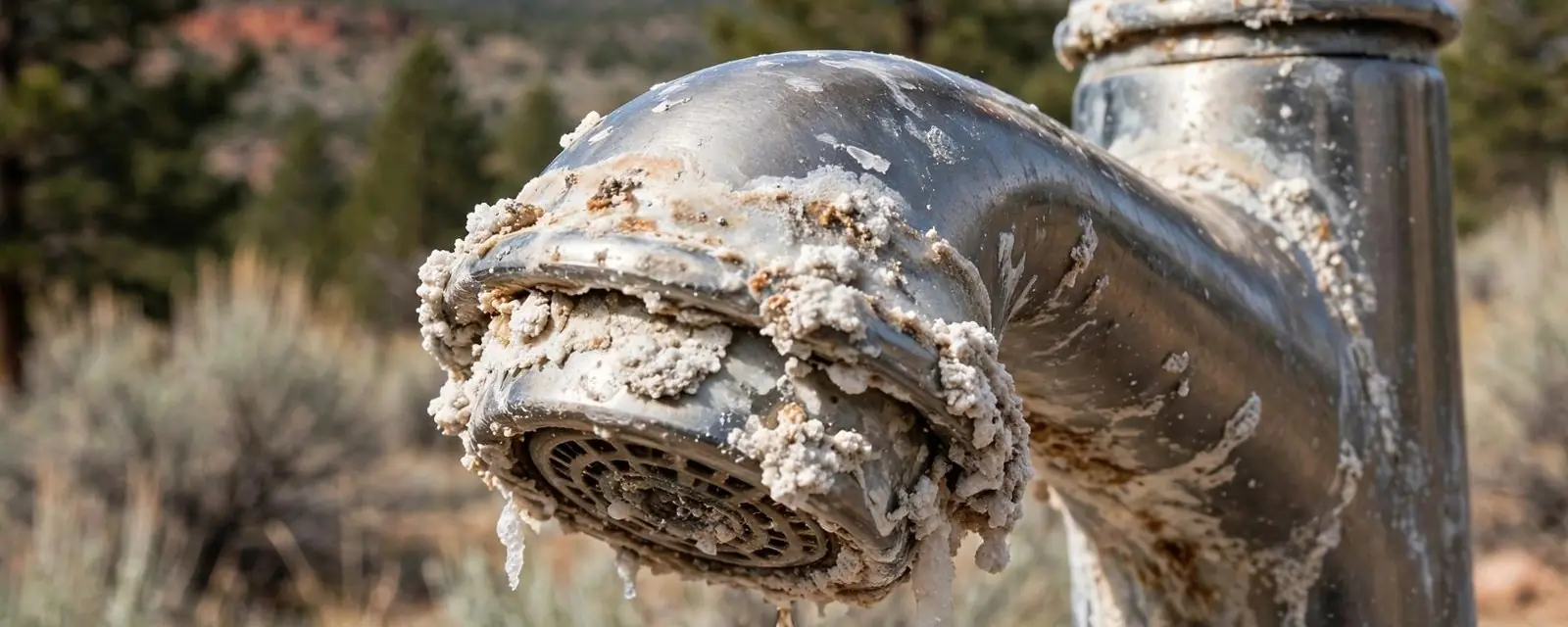
White crust on faucets and showerheads
Evaporating water leaves minerals behind.
Spots on glassware and dishes
The same minerals dry on glass.
Water heater rumbling
Scale on the tank bottom insulates the burner.
Clogged aerators and showerheads
Mineral buildup narrows the flow.
Dry skin and stiff laundry
Hard water can leave residue on skin and fabric.
If scale has already damaged a fixture, our faucet repair page covers what we replace. A scaled heater may need the steps on water heater repair or the flushing described on the tankless water heaters page.
Not sure what system fits?
Call and we will talk through your water report and your home.
Installing a softener or filter in a desert home
A softener needs a drain for its regeneration cycle, an outlet and space near the main line. Garages and utility closets are common spots. We check your water pressure, the line size and where the system will drain, and we add a bypass so the system can be serviced without shutting off water to the house.
Salt-based softeners add sodium to the wastewater, and some communities limit them. Ask us about local rules, and check with your sewer provider. On a septic property, the brine discharge can affect the tank, so we talk through the setup before installing.
Look for treatment products tested to NSF and ANSI standards for the claims they make, and note that connections follow the California Plumbing Code, which is based on the Uniform Plumbing Code (UPC).
Questions to ask before you buy a system
Ask what the system removes, what it does not remove, what it costs to run each year and who services it. Ask whether the salesperson tested your actual water or quoted a generic number. A seller who will not show you test results is selling a box, not a solution.
Be careful with free water test offers at the door. A real test uses a lab or a calibrated kit and gives numbers you can keep. If the demo changes color in a way that cannot be repeated, skip it and read the district report instead.
Maintenance you should plan for
Every system has a running cost. A softener needs salt and a check of the brine tank now and then. A carbon filter needs a cartridge change on schedule. A reverse osmosis unit needs filters and, less often, a membrane. If you skip maintenance, the system stops working well and may harm what it is meant to protect.
We can set up a schedule and leave you a short care sheet. For rentals, a labeled system and a service date on the unit helps the next person who opens the cabinet.
Water heaters, appliances and the case for treatment
The strongest case for a softener is protecting equipment. Heaters, dishwashers and washers all lose efficiency when scale builds up. If your heater rumbles or your tankless unit throws scale errors, treatment may pay for itself over time. Our tankless water heater page explains flushing, and it works well with a softener.
It depends on your water and your fixtures. Read the district report or test your tap, then decide.
A softener reduces hardness. It is not a purifier, and it does not remove most contaminants.
It filters drinking water at the tap and needs a small drain connection and periodic filter changes.
Often yes. Tell us the brand and what the system does and we will say what we can service.
It can reduce scale on the tank and elements, which may extend their life.