
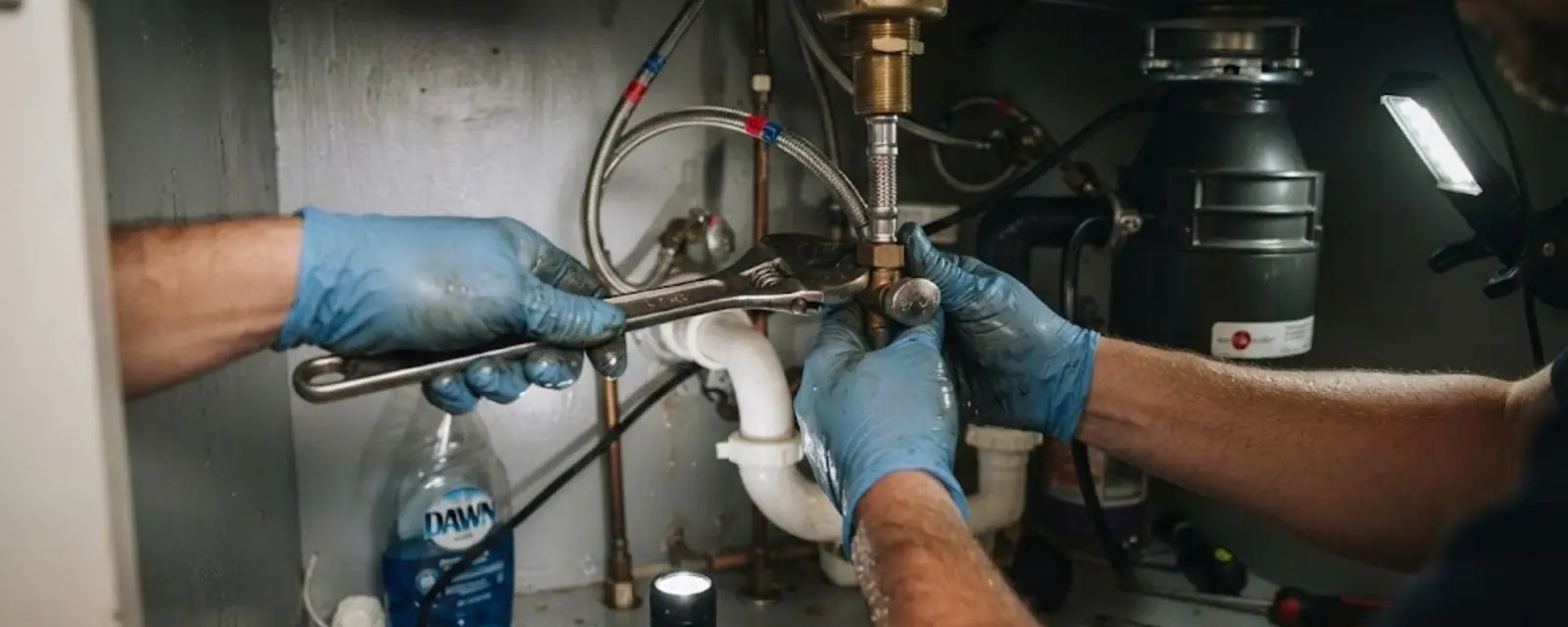
Find the leak before you fix it. Dry every joint, put a paper towel under each one, run the water and watch which towel gets wet first.
The supply side: shutoffs and lines
Two small valves, one hot and one cold, sit under the sink. They feed flexible supply lines that run up to the faucet. These valves should stop the water to the faucet when you turn them clockwise. Old valves seize or leak at the stem, and old supply lines crack or bulge.
- Turn each shutoff once a year so it does not seize
- Replace rubber supply lines that are cracked or older than ten years
- Braided stainless lines are a durable upgrade
- A wet stem or a drip at the nut means tighten gently and then replace the valve if it continues
If a shutoff will not close, you cannot work safely on the faucet. That is a good moment to call a plumber, since a stuck valve can break and flood the cabinet. Our faucet repair page covers valve replacement.
The drain side, from strainer to wall
| Part | What it does | Typical leak |
|---|---|---|
| Basket strainer | Seals the sink drain opening | Drip at the sink bottom from old putty |
| Tailpiece | Connects the strainer to the trap | Slip nut leak at the top |
| P-trap | Holds water to block sewer gas | Leak at the slip nuts or a cracked bend |
| Trap arm | Carries waste to the wall | Leak at the wall connection |
| Garbage disposal | Grinds food and drains the sink | Leak from the flange or housing |
| Dishwasher hose | Sends dishwasher water to the drain | Leak at a loose clamp |
The P-trap is the curved pipe that holds water. It blocks sewer gas, and it also catches rings and small objects. If a smell comes up through a sink, a dry or leaking trap is a common cause. Slip nuts need only hand tightening plus a quarter turn, since overtightening cracks plastic.
Which leaks you can fix yourself
Good DIY jobs
- Tightening a slip nut
- Replacing a worn washer in a slip joint
- Swapping a supply line
- Cleaning a trap
Call a plumber
- A seized or leaking shutoff valve
- A leak from the disposal housing
- A cracked drain pipe in the wall
- Repeated leaks after a repair
A leak that keeps coming back usually means the cause is not where it first appears. Water can run along a pipe and drip from a lower joint. We trace the source before replacing parts, which saves repeat visits.
Desert Hot Springs: septic and sewer under the kitchen
Kitchen drains in Desert Hot Springs connect to either a sewer main or a septic tank. Mission Springs Water District is moving about 695 properties in the northern part of the city off septic through its M2 project, and the district can be reached at 760-329-6448.
This matters for what you pour down the sink. Grease and food solids load a septic tank quickly, so a septic home should be more careful. If a kitchen drain keeps clogging, our drain cleaning page explains what we check.
The trap and vent arrangement under a sink follows the California Plumbing Code, which is based on the Uniform Plumbing Code (UPC), so avoid swapping in an S-trap or removing a trap to speed up a repair.
Cabinet floor wet?
Call and we will trace the leak and repair it.
Protecting the cabinet and the floor
A small leak can ruin a cabinet base in weeks. Particle board swells when it gets wet, and mold can start behind it. If the base feels soft or smells musty, tell the plumber, because a repair may need new flooring in the cabinet as well as new parts.
A cheap leak alarm under the sink gives early warning. Place it flat on the cabinet floor where a drip would land. It is a good idea in rentals and second homes, where nobody may notice a drip for weeks. We serve Palm Springs homes and others across the service area.
A simple monthly check that prevents big repairs
Once a month, open the cabinet and look. Touch each joint with a dry tissue, check the floor of the cabinet for dampness and smell for mustiness. Run the water and watch the drain for slow flow. A five minute check can catch a small drip before it becomes a rotted cabinet base.
Also check what lives under the sink. Cleaning products stored against pipes can corrode fittings, and boxes can hide a leak. Keep the space tidy and give yourself room to see the joints. A plastic bin under the trap catches drips and is easy to empty.
Choosing replacement parts that last
For supply lines, choose braided stainless steel. For the trap, a solid plastic or metal P-trap with a good washer set is fine. For the strainer, a stainless basket with a metal flange outlasts thin plastic. Buying a little better saves a visit later, and most of these parts cost little.
The usual causes are loose slip nuts at the trap, a worn supply line, a leaking shutoff valve or a seal at the sink strainer. Dry the joints and find which one drips first.
Hand tight plus a quarter turn is enough. Overtightening can crack plastic fittings.
Yes. A blocked drain makes water back up and push through a weak joint. Clearing the clog often stops the leak.
Many homeowners can do it. A stuck shutoff valve, corroded fittings or a disposal that makes access hard are good reasons to call.
Check your water and sewer bill, or call Mission Springs Water District at 760-329-6448. Both septic and sewer homes exist in the city.